The Top 5 Barriers to Invest
Originally published on Substack
If you know anything about investing, you’ve probably heard the same advice: the earlier you start, the better.
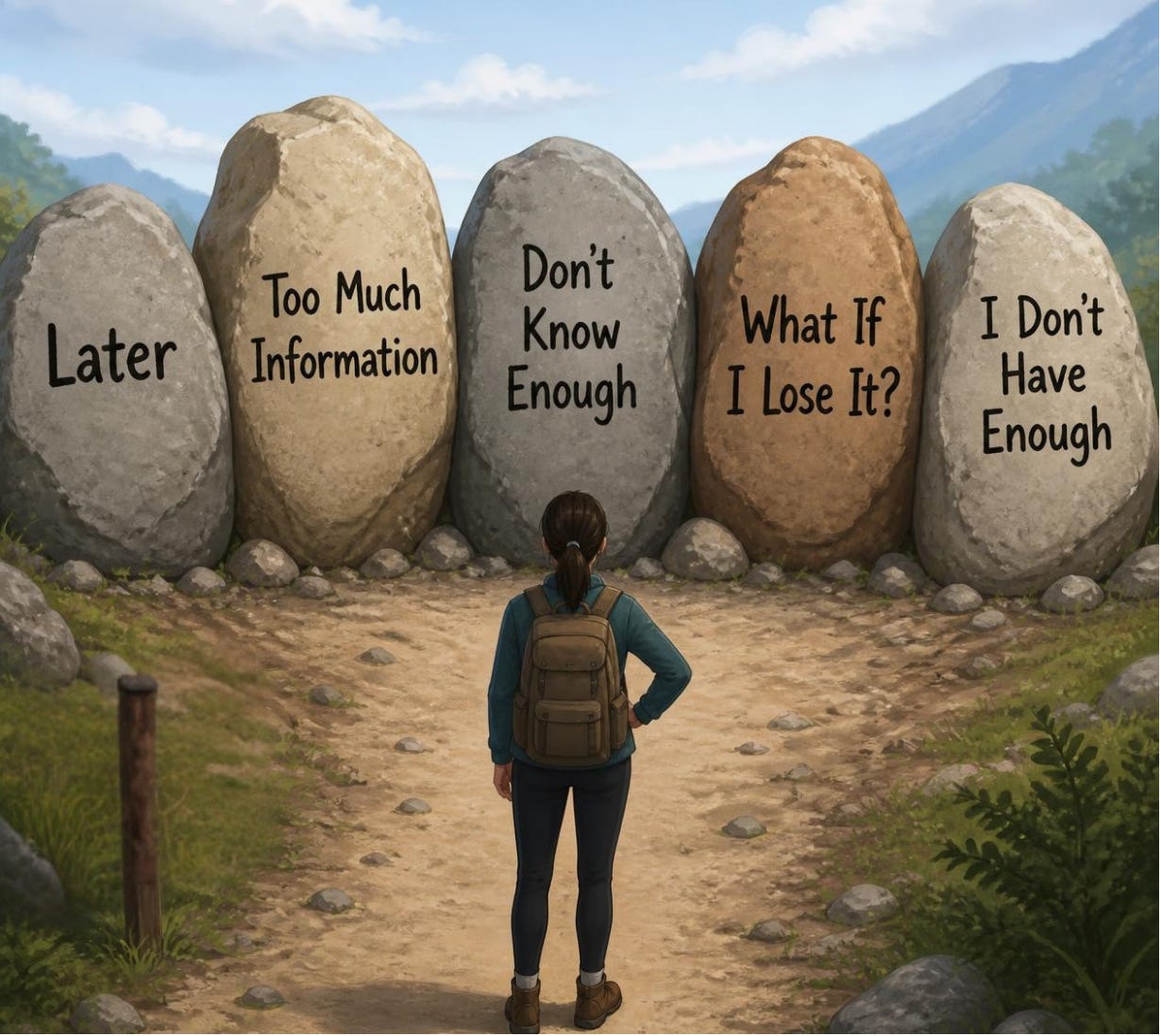
I think about that advice differently now because when I look back at my own investing journey, one thing I wish I had done was start earlier. I waited longer than I needed to, and one of the reasons I waited is actually one of the five barriers on this list.
That got me thinking about Gen Z, the youngest generation with a significant population already entering adulthood. They have the opportunity to start investing early and potentially benefit from having decades ahead of them.
So what’s stopping them?
Research suggests that the reasons people delay investing tend to fall across financial, knowledge, and psychological barriers. And when you look specifically at younger adults, some of those barriers become especially interesting.
So, let’s count down five of the biggest barriers to investing, starting with #5.
#5: Inertia & Procrastination

I’ll start when I make more money.
I’ll start after I pay off a few bills.
I’ll start next year.
Sound familiar? One of the strangest things about investing is that you can fully believe it’s a good idea and still not do it.
Behavioral economists have studied this kind of inertia extensively in retirement savings. A study by economists Brigitte Madrian and Dennis Shea examined what happened when a company changed its 401(k) plan from requiring employees to actively enroll to automatically enrolling them in the plan. The effect was dramatic.
Under automatic enrollment, 401(k) participation among employees with three to 15 months of tenure rose from 37% to 86%. [1] Investing in a 401(k) did not suddenly become better. What changed was the default: for all the employees, doing absolutely nothing now meant participating rather than not participating.
That’s a powerful lesson about human behavior. Knowing that investing is important is not enough; we also need to overcome the inertia of doing nothing.
#4: Information Overload
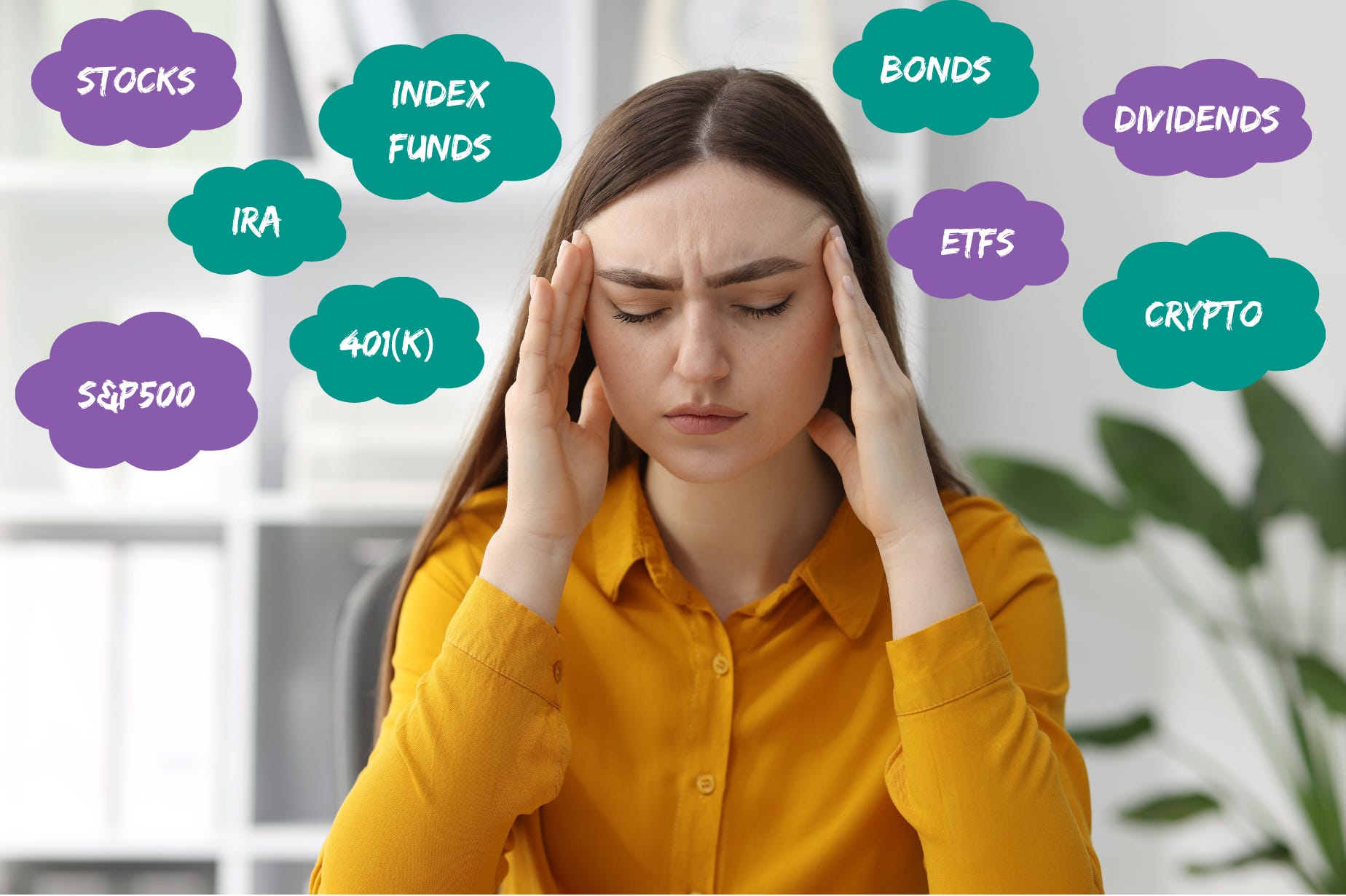
Stocks. Bonds. ETFs. Index funds. IRAs. 401(k)s. Expense ratios. Asset allocation... The list of financial products and terms goes on and on. Then there’s YouTube, TikTok, Reddit, podcasts, and countless people telling you what you must buy.
Having access to more information doesn’t necessarily make investing easier. In fact, it often leads to inaction.
Federal Reserve researchers studying information overload in financial markets noted that investors have limited capacity to process information. Their research found that greater information overload was associated with lower trading volume and was consistent with reduced decision accuracy when attention is limited. [2] Basically, people traded less when they were given too much information to process.
Today, the problem isn’t too little information. It’s often too much information.
#3: The Knowledge Gap
This sounds similar to information overload, but there’s an important difference. Information overload is: “There’s too much for me to figure out.” The knowledge gap is: “I don’t know enough to do this.” And a lot of people feel that way.
The FINRA Investor Education Foundation and CFA Institute conducted a study of Gen Z investors and non-investors and found that more than half of Gen Z respondents surveyed in the U.S. (56%), Canada (56%), and U.K. (58%) cited a lack of knowledge about investing as a barrier to investing. [3]
A similar study from Wells Fargo found that among Americans surveyed who did not have money in the stock market, 50% cited lack of knowledge as a barrier to investing. [4]
Investing can feel like something you need to understand completely before you’re allowed to participate. And that can make taking the first step intimidating.
#2: Fear & Risk Aversion

This fear is different from the others because it isn’t irrational. You certainly can lose money investing. All investments involve some degree of risk, and depending on the investment, an investor could lose some or all of the money invested. So it’s understandable that fear can stop people from participating.
In fact, in the same Wells Fargo survey, among Americans surveyed who did not have money in the stock market, 68% said they were unwilling to risk their money. That was the most commonly cited reason among those surveyed. [5]
This is one of the hardest barriers on this list because, unlike procrastination or lack of knowledge, we can’t simply make ‘risk’ in investing disappear.
#1: Lack of Capital

This one is personal for me. When I think about my younger self and why I waited to start investing, it wasn’t because I didn’t think investing was important. I simply didn’t have enough money.
As a student on financial aid, working two jobs, every cent was accounted for, leaving nothing for investing. And so investing felt like something I would do later, when I made more money and had more savings.
The FINRA Foundation and CFA Institute survey found that lack of savings was the top reason Gen Z non-investors surveyed in the U.S., Canada, and China gave for not investing. [6]
Investing doesn’t necessarily require the large amount of money some people imagine it does. For instance, ETF shares (which are a collection of many different stocks or bonds bundled into a single investment to spread risk) can often be purchased for relatively low dollar amounts.
But if money really is tight, the question is: how do people get more money to start investing early?
So, How Do We Get Past These Barriers?
Identifying what’s stopping you from investing is only half of the conversation. The other half is how you overcome these barriers.
How do you stop saying “I’ll do it later”? Or make investing feel less overwhelming? How do you start when you don’t feel like you know enough? And what happens when the biggest thing stopping you is the same thing that stopped me: you don’t feel like you have enough money?
That’s what we’ll explore in Part 2: How to Overcome the 5 Biggest Barriers to Investing. As a sneak peek, four of these barriers can be overcome. But one of them can never really be eliminated. We’ll delve into what we can actually do about the other four.
With lots of love,
Your godmother Ada
Disclaimer: As someone in finance as a regulated investment professional: I’m not your financial adviser, and this post is education, not personalized advice. All investments carry risk including possible loss of principal, and past performance doesn’t guarantee future results. Talk to a professional who knows your full situation before making money moves.