Popular vs. Practical
The ETFs Everyone Talks About and What to Buy Instead
Originally published on Substack

You’ve heard the names. SPY. QQQ. Maybe VOO. They’re all over financial TikTok, Instagram, and Reddit threads. These ETFS (exchange-traded funds) are not bad investments. But “popular” and “the smartest choice for your money” are two very different things.
Two ETFs can track the same exact index, hold the same companies, perform almost identically, and one can silently eat thousands more of your money in fees over time. And the only difference is the name and who’s selling it.
So, let’s dive into some numbers.
Real Math on the ‘Fees’
Some of you may have heard of the term “expense ratio” when dealing with ETFs. An expense ratio is a fee you pay every single year, whether your investment goes up or down. It compounds against you the same way ‘returns’ compound for you.
Let’s work through an example:
💰 $10,000 invested (using a 7% annual return over 30 years)
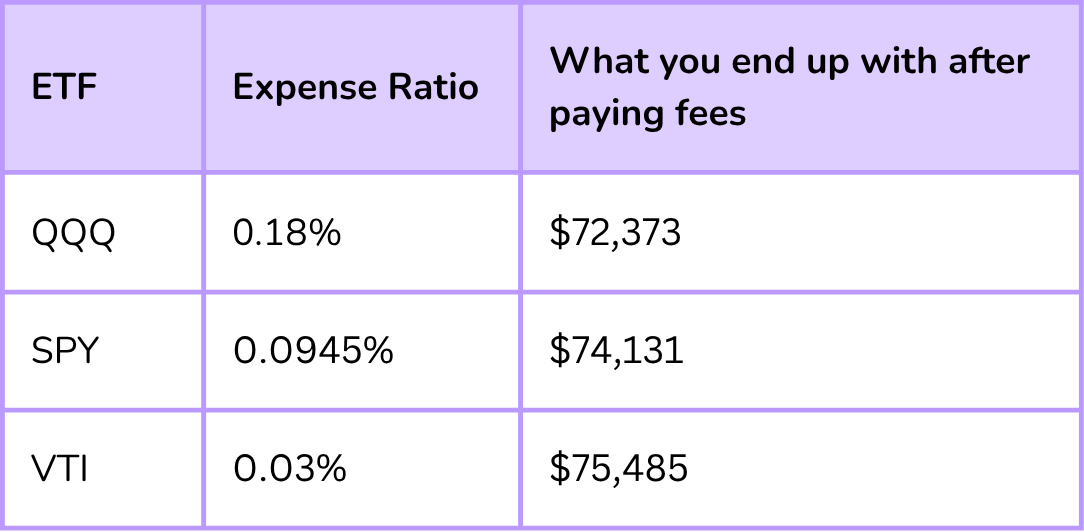
Same market. Same 30 years. The difference between QQQ and VTI is $3,112 on a $10,000 investment.
Now, let’s scale that up. $50,000 invested over 30 years:
💰💰💰💰💰 $50,000 invested (using a 7% annual return over 30 years)
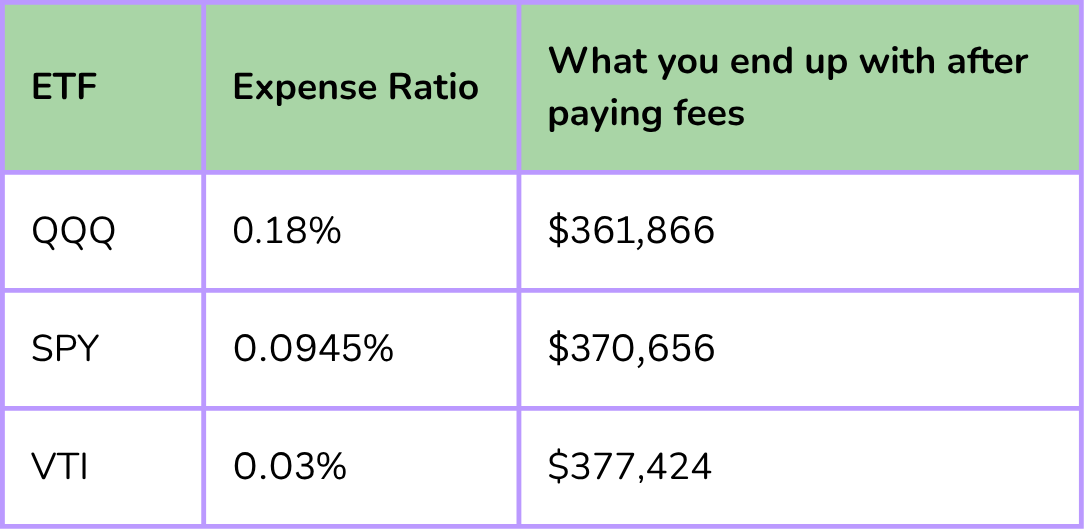
Now, the difference is larger: $15,558 more in your pocket with VTI vs. QQQ. And this is not because VTI outperformed QQQ. It just cost you a lot less to hold it.
What to Do Instead
SPY, VOO, and VTI: what’s the difference?
SPY (SPDR S&P 500 ETF Trust) is the oldest ETF in the US. It’s a Wall Street institution. It tracks the S&P 500 i.e., the 500 largest American companies. Of course, it’s a totally fine investment.
But SPY charges 0.0945% per year. VOO (Vanguard S&P 500 ETF) tracks the exact same 500 companies and charges 0.03%. That’s one-third the price. VOO will actually edge out SPY in net returns over time because you’re losing less to fees every year.
And if you want to go one step better? VTI (Vanguard Total Stock Market ETF) also charges 0.03%, but it holds roughly 3,700 US companies instead of 500. That’s more diversification at the same cost. You get the whole market, not just the largest names.
The only reason SPY still dominates is institutional traders who need its massive liquidity for rapid in-and-out trading. The average investor like you and I are not doing that. We’re building wealth, so VTI is a more practical choice.
QQQ: the cost of concentration
QQQ (Invesco QQQ Trust) tracks the NASDAQ-100 i.e., roughly the 100 largest non-financial companies on the Nasdaq exchange. About 50% of it is technology and it’s had incredible runs. It also had brutal drops.
Two issues. First, QQQ charges 0.18% which is six times what VTI costs. Second, a ~50% tech concentration means you’re not really diversified. You’re making a specific bet that tech keeps winning. That’s not necessarily wrong, but it’s a knowingly concentrated position, not a core portfolio holding. And yes, QQQ has historically outperformed the broader market but that outperformance came with significantly higher volatility, deeper drawdowns, and a fee that compounded against you every year regardless of how the market moves.
If you want a growth tilt without the concentration and fee problem, VUG (Vanguard Growth ETF) holds about 155 large-cap US growth companies at 0.04% . That is 4.5x cheaper than QQQ. It’s still tech-heavy at around 50%, but the other half spans health care, consumer, industrials and more, making it meaningfully broader than QQQ’s which has very little outside tech and communication services..
FOMO on the “hot” one? Why boring usually wins
Chasing the ETF everyone’s talking about is how you end up with something concentrated, expensive, and bought at its peak.
Meanwhile, VTI, or a simple two-fund combination of VTI + VXUS (international stocks) has held up against more “exciting” strategies over 20+ years, net of fees. It’s not magic, it’s just cheaper, diversified, and hopefully you’ll actually hold it through the dips instead of panic-selling when the headlines get scary.
Instead of getting swayed by whatever is trading, take some time to do some research because a ‘boring’ market fund might actually be a better choice for you.
Popularity is a marketing metric. Fees are math. Choose math.
With lots of love,
Your godmother Ada
Disclaimer: As someone in finance as a regulated investment professional, I want to be clear: I’m not your financial adviser, and this post is education, not personalized advice. All investments carry risk including possible loss of principal, and past performance doesn’t guarantee future results. Talk to a professional who knows your full situation before making money moves.