Don't Swing for the Fences
Why most of us should invest like we’re playing the long game.
Originally published on Substack
If you’ve been anywhere near financial news in the last two weeks, you’ve heard about the SpaceX IPO. The biggest IPO in history. Elon Musk. Rockets. Starlink. The future. The hype was absolutely deafening.
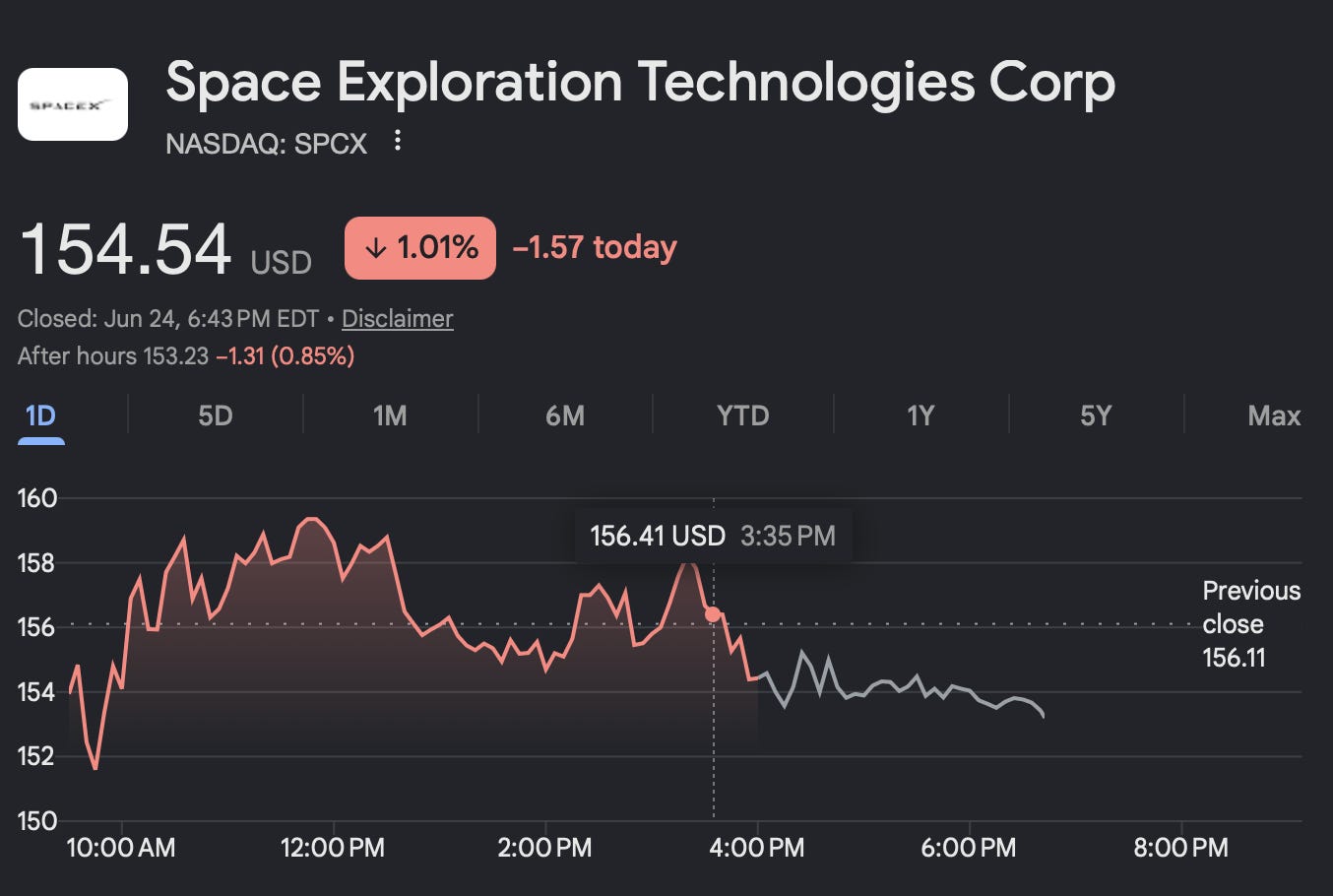
And of course, the excitement made sense. SpaceX is a genuinely remarkable company. It IPO’d on June 12th at $135 a share, opened trading at $150, and kept climbing [1]. By June 16th, it hit a high of $225 a share. I’m sure people who got in early were feeling like geniuses.
Then came Monday, June 22nd.
The stock dropped sharply and kept falling [2]. By June 24th (just twelve days after the IPO), it was sitting around $154. Investors who bought near that $225 peak had already lost nearly a third of their money. And the people who piled in during the first day of excitement, buying at $160 or higher? They’re barely above water, if they’re lucky.
This is the part of the IPO story that almost never makes the headlines.
We’ve Seen This Movie Before
SpaceX isn’t an outlier. This is a pattern so well-established that Wall Street analysts literally joke about it. Let’s look at a few examples that should sound familiar.
Rivian (2021): When electric truck maker Rivian went public in November 2021, it was one of the biggest parties Wall Street had thrown in years. The stock surged from $78 all the way past $170 within days, briefly making Rivian worth more than Ford. Rivian hadn’t delivered a single truck yet, while Ford actually sells cars. By May 2022, the stock had crashed 80%. Today it’s down about 91% from its peak.
Uber (2019): The app on everyone’s phone. Banks valued it at up to $120 billion. Then it actually went public and the stock went down on day one. Investors collectively lost $655 million in a single day. It took years for Uber to recover, and a lot of stomach to stay in.
Facebook (2012): Everyone was going to be rich. The stock priced at $38, NASDAQ’s systems glitched on opening day, and then it just fell. For over a year, Facebook traded below its IPO price. Early retail investors sat on painful losses while insiders who got shares before the IPO had already made their money. Facebook obviously turned out fine eventually, but if you panicked six months in, you locked in a loss on what became one of the greatest companies of the decade.
So Who Actually Wins?
The people who made real money on SpaceX, Rivian, Uber, and Facebook weren’t the people who saw the IPO news and rushed to buy shares.
They were the venture capitalists, private equity firms, and institutional investors who got in years before anyone else had the chance. By the time a company goes public, the big money has already been made.
The IPO is essentially the moment when the people who made the real money get to sell to the rest of us.
A study of 27 major tech IPOs found that the average first-day return for retail investors i.e., people who could only buy after trading opened publicly, was actually negative. More than two-thirds of major IPOs closed below where everyday investors could first buy them. The rare wins, like Google, pulled up the average for everyone else.
The Wealthy Play by Different Rules
Very wealthy investors can afford to take these kinds of swings. It’s not because they’re smarter than you but because they can afford to be wrong.
If someone with a $50 million net worth puts $2 million into an IPO and it drops 50%, that’s painful on paper. But it doesn’t change their life. They still have their house, retirement fund, kids’ college funds etc..They absorb the loss and move on or hold the investment till they recuperate their losses.
For most of us, that’s not the situation. Putting a meaningful chunk of your savings into the hottest IPO of the year, based on excitement, hype and headlines, isn’t a simple portfolio adjustment if it drops 50%.It’s a life disruption. It can set back your retirement by years. It can wipe out a down payment.
Wealthy investors also tend to get access to IPO shares at the offering price before the hype inflates the stock. By the time you and I can buy SpaceX shares, we’re buying from people who got in at $135 or below. The house always wins.
What Most of Us Should Actually Do
Boring, steady, and consistent investing isn’t exciting. Nobody is going to congratulate you for maxing out your 401k and putting it in index funds. But it works.
The simplest version of smart investing for most people looks something like this:
Invest regularly, not reactively. Don’t wait for the hot IPO or the exciting news cycle. Invest consistently, every month, regardless of what the market is doing. This is called dollar-cost averaging. It’s boring in the best possible way.
Diversify. Don’t bet everything on any single company, no matter how good the story sounds. If SpaceX really does conquer the solar system, your index fund will reflect that. If it craters, your index fund will barely notice.
Think in decades, not days. The people who made real money in the stock market over the last 30 years weren’t chasing IPOs. They bought boring funds, reinvested their dividends, and didn’t panic when things got rough.
Keep your emergency fund separate. Before investing in anything exciting, make sure you have 3 to 6 months of living expenses somewhere safe and accessible. That cushion means you’ll never be forced to sell at the wrong time.
SpaceX might be a great company. It probably is. But a great company and a great investment at a specific price, at a specific moment in time, are two very different things.
Taking big swings on IPOs may feel like the way you’re supposed to build wealth: spot the next big thing, go all in and then ride the rocket. But for most of us it’s not investing, it’s gambling.
The consistent investor who automatically puts money into a diversified portfolio every paycheck, barely looking at it, almost always beats the person chasing headlines. That’s not as fun as telling people you got in on SpaceX but your investment or retirement account doesn’t care about fun.
With lots of love,
Your godmother Ada
Disclaimer: As someone in finance as a regulated investment professional, I want to be clear: I’m not your financial adviser, and this post is education, not personalized advice. All investments carry risk including possible loss of principal, and past performance doesn’t guarantee future results. Talk to a professional who knows your full situation before making money moves.